Inside EdgeHurricane doors
- Part
- Wind struts & anchors
- Usual time on site
- One install day after the permit, then two inspections
- Permit
- Required for a new door
- Call or text
- (954) 947-4016

A new garage door on a Pembroke Pines home must be impact-rated, or sit behind an approved shutter, because Broward sits inside the code's High-Velocity Hurricane Zone (HVHZ), where houses are designed for 170 mph winds. Here's what that means inside the door, how to separate a real approval from a sales line, and how the door figures on a wind mitigation form and in a sales tax refund.
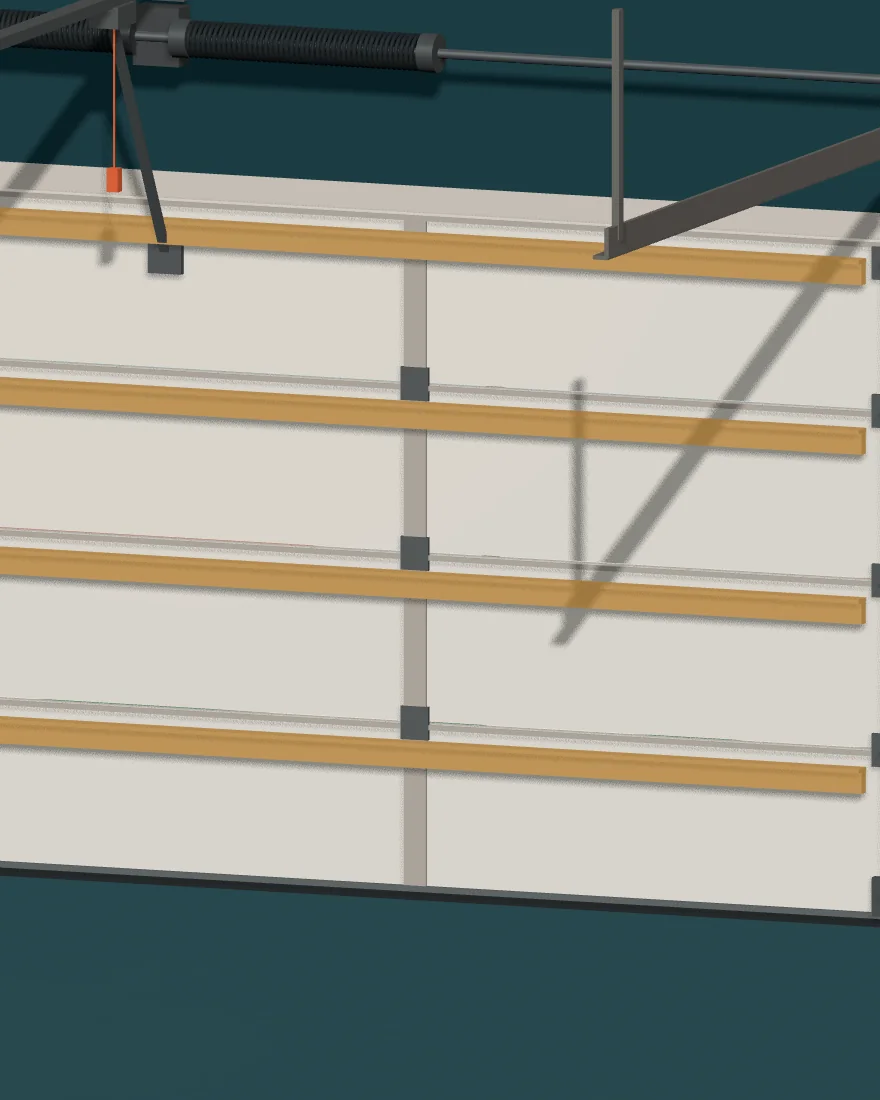
The 3D model lights up the steel struts that run across the inside of the sections and the brackets that hold the tracks to the wall. In a strong gust, they keep the sections from bowing in and the edges from pulling out of the tracks. The door's approval drawing sets how many struts go on, where they sit and how the tracks are fastened, so they're part of the rating.
A house in Pembroke Pines is designed for a 170 mph wind. Section 1620.2 of Florida’s building code (2023, 8th Edition) sets that speed for Broward buildings in Risk Category II, the category homes fall in; Miami-Dade's figure is 175. You'll see 165, 180 or 200 in ads, but for a Broward house the code says 170.
Wind speed is one test, and impact is the other. Under Section 1626, up to 30 feet above ground, every garage door must survive a 2×4 weighing 9 lb shot at 50 ft/s and then hold under repeated pressure, or be covered by a shutter that does. The pressure each door has to resist is set by its size and by the house; the county's worst-case chart puts a 16×7 door at +37.0 / −45.0 psf, and the full chart is in our permit guide.
A Florida product approval can be registered for use inside the HVHZ, outside it, or both, and some garage doors carry a Florida number that says no to the HVHZ. Those doors can be legal elsewhere in the state and still fall short in Broward. Miami-Dade's Notice of Acceptance, or NOA, is issued for the HVHZ, and the state listing answers the question in a field called Approved for use in HVHZ. Check that line for the exact model, size and glass, because the same door can be approved with impact glass and not with plain glass.
Approvals also run out. Every NOA states an expiration date, and a door bought today has to be covered by one that's current. Our guide to reading the label shows how to look up either kind of number yourself.
The rating belongs to the whole assembly in the approval drawing: the sections, the struts and where they sit, the track gauge, the hinges, plus the anchors and their spacing into the wall. Swap one of those for a part the drawing doesn't list, and the door may no longer be the door that passed the test, however smoothly it runs.
So on an impact door, struts, hinges, tracks and anchors get parts that match its approval, and if a matching part can't be had, we say so before removing anything. There's no such thing as a hurricane spring: springs balance the door's weight, and the wind load rides on the sections, struts, tracks and anchors. An impact door is heavier, so a spring replacement on one is sized to that door, not to a lighter one.
A storm brace, the post or bar some owners add to an older door, can stiffen it for a storm. It doesn't give the door an approval number. Some bracing systems carry a product approval of their own and many don't, and one without it leaves a wind mitigation inspector nothing to verify. If you use one, follow its instructions for your door's size, keep the opener unplugged while it's in place, and treat it as a bridge to a rated replacement door.
Your wind mitigation report grades the garage door too. The state's mitigation form, revision 04/26 of OIR-B1-1802, mandatory from April 1, 2026, lists garage doors with the other openings and grades the house by the weakest protection it finds. For the impact grade, the door must be tested to an impact standard on the form's list (for garage doors, ANSI/DASMA 115 is one; TAS 201, 202 and 203 is another), backed by a photo or document the inspector can attach. A door verified only for pressure ranks lower, and an opening that needs replacing keeps the house out of the mitigation credits altogether. What the grade does to your premium is your insurer's answer, not ours.
The state also gives back the sales tax on impact-resistant garage doors purchased between July 1, 2026 and June 30, 2029 (Florida Department of Revenue, TIP 26A01-09). It's a refund, not a discount at the register: up to $500 per owner, for one homestead property with a site-built house and a just value of $700,000 or less, claimed on forms DR-26S and DR-26HH by September 30, 2029. When a contractor supplies and installs the door for one price, the owner files with the supplier's receipt to the contractor showing the tax paid, and we hand you that receipt with the job papers.
My Safe Florida Home, the state's home hardening grant program, counts garage doors as opening protection in its statute, for homestead homes that meet its other rules. Money for it depends on what the Legislature sets aside, so check mysafeflhome.com for current funding before you plan around it.
Do the first list in June and repeat the last two items when a storm is named for South Florida. During Irma in 2017, a private weather station in Pembroke Pines caught a 109 mph gust, and Broward filed 38,836 insurance claims (National Weather Service).
Yes: an impact door is a replacement door, so Pembroke Pines requires a permit with structural review and two inspections, as our permit guide explains.
An approval for that exact model, size and glass, showing it passed the impact and pressure tests, and a permanent label that ties the door to it. In Pembroke Pines the approval must cover the HVHZ, which means large-missile impact and Broward's 170 mph design wind, and it has to be current when the door is bought.
Only if its Florida approval says it's approved for use in the HVHZ; some Florida-approved doors are approved only outside it, while Miami-Dade issues its NOAs for the HVHZ. Either way, check the exact model, size and glass.
It can, through the wind mitigation form: a rated, documented door can raise the opening protection grade, because the form grades the whole house on its least protected opening, which can be the garage door. Your insurer decides how much that moves the premium; we don't quote discounts.
Yes, if you qualify: the Florida Department of Revenue refunds up to $500 of sales tax on impact-resistant garage doors purchased between July 1, 2026 and June 30, 2029, for one homestead property with a just value of $700,000 or less (TIP 26A01-09). You file forms DR-26S and DR-26HH with the receipt that shows the tax paid.
No. Springs balance the door's weight; the wind load is carried by the sections, struts, tracks and anchors in the approval. A heavier impact door needs a spring sized to it, but a spring sold as hurricane-rated is a sales line.
A person answers 24/7. If it isn't urgent, a photo of the wind struts & anchors helps us bring the right part.
Texting works from a phone. From this computer, call (954) 947-4016, or send the photo from your phone to the same number.